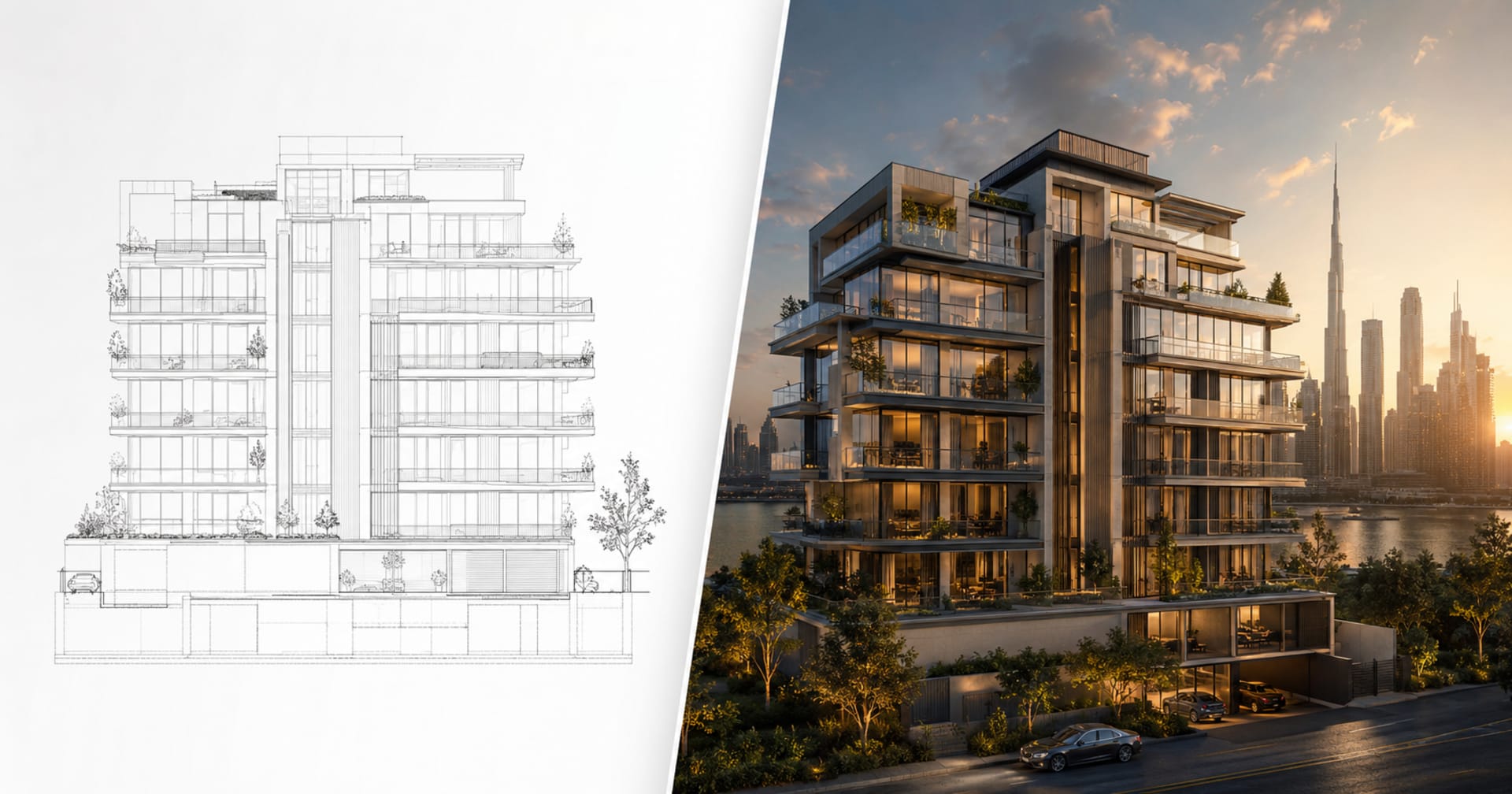
3D Real Estate Visualization: The Complete Guide for Developers (2026)

What is 3D real estate visualization?
3D real estate visualization — also referred to as real estate visualisation in the UK and UAE markets — is the process of creating photorealistic, interactive digital representations of properties before construction begins. It allows buyers to explore every unit, view, and layout in real time, from any device, anywhere in the world.
The global 3D rendering market is valued at $2.25 billion in 2026 — and real estate is its single largest segment. Over 72% of real estate firms in urban areas have already adopted 3D visualization to pre-sell properties and visualize unbuilt projects.
For property developers, 3D real estate visualization (also called real estate visualisation) is no longer a differentiator — it is quickly becoming the baseline expectation. Buyers in Dubai, London, Singapore, and New York expect to experience a property before they commit. And the developers who deliver that experience are selling faster, at higher prices, with fewer cancellations.
This is the complete guide to 3D real estate visualization in 2026 — what it is, how it works, what it costs, what ROI to expect, and how to choose the right platform for your development.
What's in This Guide:
- What is 3D Real Estate Visualization?
- Types of 3D Visualization for Real Estate
- The ROI: What the Data Shows
- How the Process Works
- 3D Visualization for Off-Plan Developments
- Choosing the Right Platform
- How Much Does It Cost?
- Global Market Applications
- How Intwopixel Delivers It
- FAQ
1. What is 3D Real Estate Visualization?
3D real estate visualization is the process of creating photorealistic, interactive digital representations of properties — before, during, or after construction. Using advanced computer-generated imagery (CGI), architectural drawings and design concepts are transformed into immersive visual experiences that buyers, investors, and stakeholders can explore from any device, anywhere in the world.
Unlike traditional 2D floor plans or static photography, 3D visualization captures the full spatial experience of a property — the materials, the light, the views, the scale. For off-plan developments, it bridges the most critical gap in the sales process: making buyers feel confident about something that doesn't physically exist yet.
The technology has evolved significantly. What once required expensive specialist hardware and weeks of rendering time can now be delivered as a real-time interactive platform — accessible in a browser, on a phone, at a sales center touchscreen, or during an international roadshow in London or Singapore.
2. Types of 3D Visualization for Real Estate

Exterior Rendering — Photorealistic images of building facades, landscaping, and surrounding environment. Essential for establishing the visual identity of a development in marketing materials, project portals, and investor presentations. Can show day/night variations, seasonal conditions, and surrounding context accurately.
Interior Rendering — Detailed visualizations of apartment interiors, lobbies, amenity spaces, and common areas. Shows material finishes, furniture arrangements, lighting design, and spatial proportions with photorealistic accuracy. Critical for helping buyers understand what their future home will look and feel like.
3D Floor Plans — Elevated perspective floor plan visualizations that show layout, room proportions, and spatial flow more intuitively than traditional 2D drawings. Particularly effective for helping buyers understand how units will be used day-to-day.
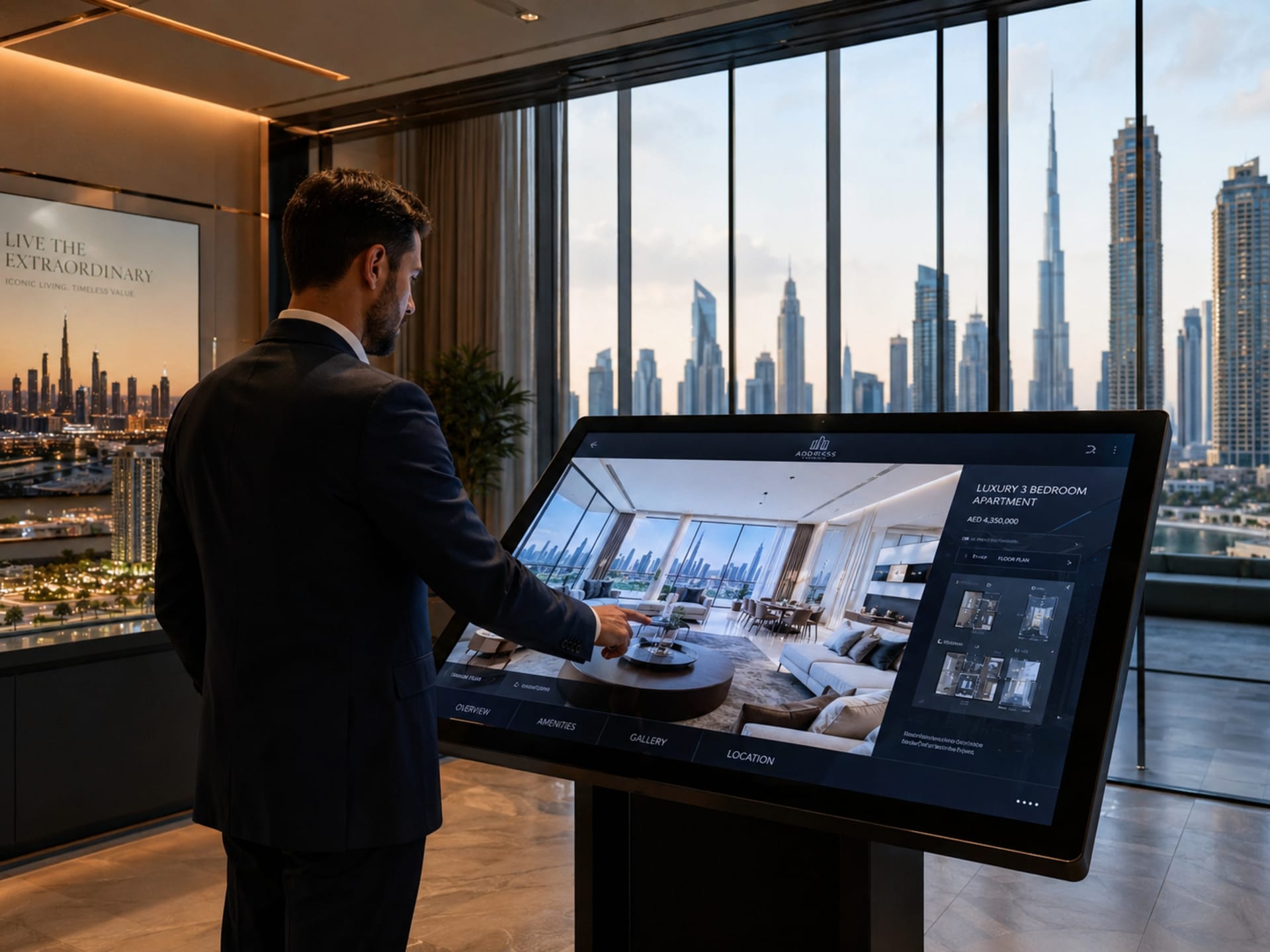
Interactive 3D Walkthrough — A real-time, navigable digital environment where buyers explore properties unit by unit, floor by floor. The most powerful format for off-plan sales: buyers select their preferred unit, explore every room, view the balcony perspective, and compare finishes — all in real time, on any device. This is the core of Intwopixel's 3D Sales App.
Virtual Property Tour — 360° immersive tours of individual units or spaces, often delivered as linked panoramic views. Effective for showcasing completed properties or show units to remote buyers.
Aerial / Bird's Eye Visualization — Site-level and masterplan visualizations showing the development in context of its surroundings — roads, landmarks, transport links, and neighbouring amenities. Essential for mixed-use and large-scale developments.
3. The ROI of 3D Real Estate Visualization: What the Data Shows
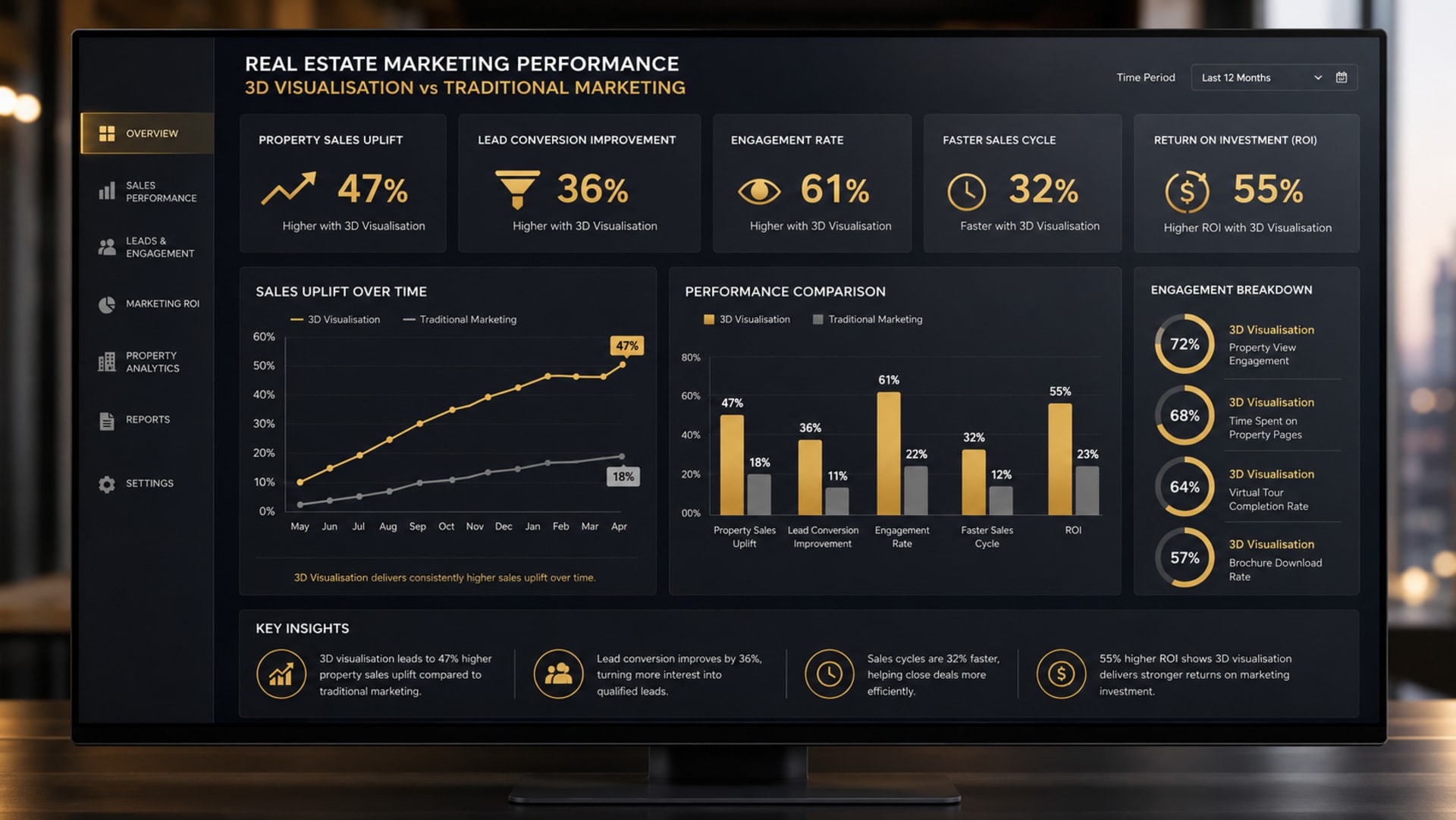
The business case for 3D visualization is strong and well-documented. Here is what developers globally are seeing:
Faster Sales
Properties marketed with 3D visualization sell 20–31% faster than those relying on traditional marketing. The 3D rendering market reports that visualization has shortened project timelines by up to 32% on average across real estate and architecture firms. For off-plan developments where holding costs accumulate daily, this acceleration directly impacts profitability.
Higher Prices
Buyers who can see photorealistic representations of their future home — the materials, the views, the light — demonstrate lower price sensitivity. Studies consistently show properties marketed with high-quality 3D visuals achieve 3–9% higher sale prices compared to equivalent properties without visualization. On a $500,000 apartment, that is $15,000–$45,000 per unit.
More Inquiries, Better Leads
Properties with 3D visualization receive significantly higher engagement online:
- 118% more online views compared to standard listings
- 87% higher engagement rates on property portals
- 40% fewer unnecessary site visits — buyers pre-qualify themselves virtually
- 77% of buyers feel more confident after experiencing a virtual tour (NAR)
Remote Buyer Conversion
For international markets — Dubai, UK, Southeast Asia — where the majority of buyers purchase remotely, 3D walkthroughs are transformative. Remote buyers who use virtual property tours are 40% more likely to complete a purchase compared to those relying on photos alone. This is the metric that matters most for off-plan developers selling to an international buyer base.
Market Growth Context
The global 3D rendering market is growing at a CAGR of 19.2% through 2035, with real estate accounting for the largest segment share. Over 69% of architectural firms globally now use 3D rendering tools. Developers who have not yet adopted interactive 3D visualization are increasingly at a competitive disadvantage in markets where it has become the norm.
4. How the Process Works: From Blueprints to Live Platform
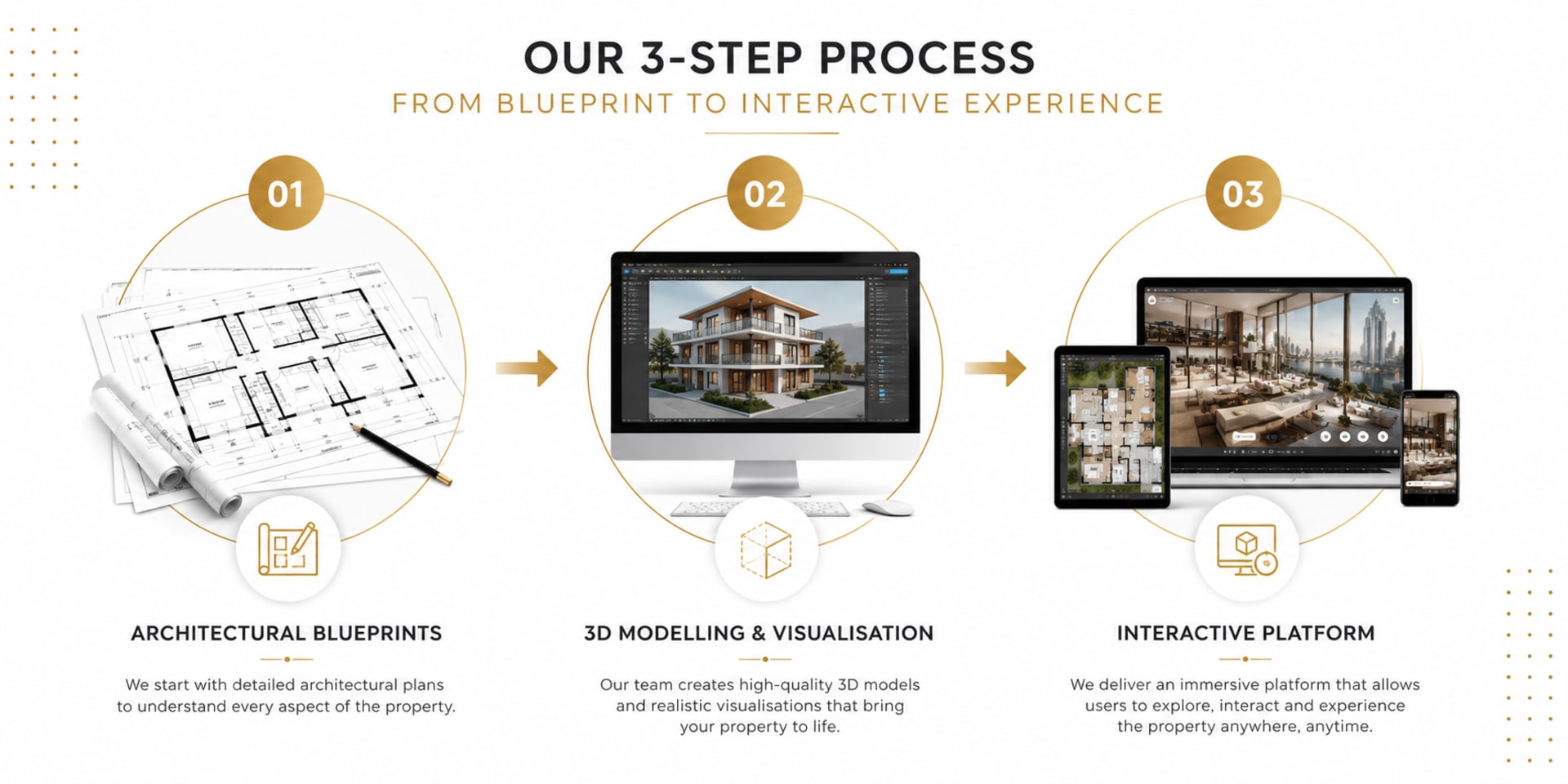
Understanding the production process helps developers plan their launch timeline and provide the right inputs. Here is how a professional 3D visualization platform is built:
Brief & Asset Collection
The developer provides architectural drawings (CAD files, PDFs), material specifications, furniture selections, brand guidelines, and project scope. The more detail provided at this stage, the more accurate the final output.
3D Modeling
The visualization team builds accurate 3D models of all unit types, common areas, building exterior, and site context. This is the most time-intensive phase and forms the foundation for everything that follows.
Texturing & Lighting
Materials are applied — marble floors, glass facades, timber finishes, fabric textures — with photorealistic accuracy. Lighting is set up to accurately simulate natural light at different times of day and artificial lighting conditions.
Interactive Development
The rendered assets are integrated into an interactive platform — the unit selector, navigation system, floor plan overlay, CRM connection, and user interface. This transforms static renders into a navigable experience.
Review & Refinement
The developer reviews the platform and provides feedback. Finishes are adjusted, layouts refined, and any inaccuracies corrected before launch.
Launch & Integration
The platform goes live — embedded in the developer's website, deployed on sales center touchscreens, integrated with the CRM, and optimized for mobile. Sales teams are trained on how to use it effectively.
At Intwopixel, this entire process takes an average of 8 weeks from brief to live platform.
5. 3D Visualization for Off-Plan Developments
Off-plan property sales present the most compelling use case for 3D visualization. When selling a development that doesn't physically exist yet, visualization is not supplementary to the sales process — it is the sales process.
The critical challenge: buyers are being asked to commit significant capital — often hundreds of thousands or millions of dollars — to something they cannot see, touch, or visit. The gap between a developer's vision and a buyer's confidence is the gap that 3D visualization closes.
For off-plan developments specifically, an effective 3D visualization strategy includes:
- Interactive unit explorer — every unit type, floor, and orientation selectable
- Real balcony perspectives — accurate views based on actual position in the building
- Availability overlay — real-time unit availability integrated with sales data
- Finish selector — standard vs premium material options visible in real time
- Day/night lighting modes — property experience across different times of day
- CRM integration — buyer behavior data flowing into the sales pipeline
For a deeper dive into this topic for the Dubai market specifically, read our guide: 3D Property Walkthrough for Dubai Off-Plan Developments: Complete Guide 2026.
6. Choosing the Right 3D Visualization Platform
Not all 3D visualization is created equal. Here is what to evaluate when choosing a platform for your development:
| Criteria | What to Look For |
|---|---|
| Visual Quality | Photorealistic 4K rendering — not stylized or cartoon-like. Ask for portfolio examples from real projects. |
| Performance | Must load fast and run smoothly on mobile devices — where most buyers will access it. |
| Interactivity | Real-time unit navigation, not just pre-rendered video walkthroughs. |
| CRM Integration | Buyer behavior data must flow into your sales pipeline. |
| Delivery Timeline | 8–12 weeks is standard. Faster claims without portfolio evidence are a red flag. |
| Accuracy | Platform must be built from actual architectural drawings — not generic templates. |
| Support | Updates as the development progresses, post-launch technical support. |
The most common mistake developers make: choosing a provider based on price alone. A low-quality 3D visualization that doesn't accurately represent the development — or performs poorly on mobile — can actively damage buyer confidence rather than build it.
7. How Much Does 3D Real Estate Visualization Cost?
3D visualization costs vary significantly depending on scope, quality, and delivery format. Here is a general framework for 2026:
| Format | Typical Range | Best For |
|---|---|---|
| Static exterior render | $500–$3,000 | Marketing materials, brochures |
| Interior renders (per image) | $300–$2,000 | Listings, portals, print |
| 360° virtual tour | $2,000–$10,000 | Single unit showcase |
| Interactive 3D walkthrough platform | $10,000–$50,000+ | Off-plan sales, full development |
| Full 3D sales app with CRM | $20,000–$80,000+ | Large developments, luxury market |
The right metric for evaluating cost is not the absolute price — it is cost per unit sold. For a development of 200 units, a $30,000 interactive platform represents $150 per unit. If it helps sell those units 30% faster and at 5% higher prices, the ROI is measured in millions, not thousands.
Contact Intwopixel for a project-specific quote — most of our developments are delivered within the $10,000–$50,000 range depending on scale.
8. Global Market Applications
3D visualization has different applications and priorities depending on the market:
UAE & Dubai
The world's most active off-plan market. Interactive 3D walkthroughs are now standard for major developments. The international buyer base — 180+ nationalities — demands remote access to property experiences. Read our complete Dubai guide →
United Kingdom
Strong adoption among London developers and national housebuilders for Help to Buy and new-build marketing. Remote buyers — particularly from the Middle East and Asia investing in UK property — respond strongly to interactive visualization.
Southeast Asia (Malaysia, Singapore)
High-growth markets with sophisticated buyer expectations. Malaysian developers have been among the earliest Asian adopters of interactive 3D sales platforms. GCC investors targeting Malaysian property rely heavily on virtual tours.
GCC (Saudi Arabia, Qatar, Kuwait)
Rapidly expanding real estate sectors with government-driven development programs. Visualization is increasingly required for large-scale residential and mixed-use projects targeting both local and international buyers.
Pakistan
A market in transition, with major developers in Karachi, Lahore, and Islamabad adopting 3D visualization for flagship projects. The overseas Pakistani investor base — particularly in the UK, UAE, and USA — is a strong driver of demand for virtual property experiences.
9. How Intwopixel Delivers 3D Real Estate Visualization
Intwopixel is a specialist 3D property visualization platform built specifically for real estate developers. We don't do generic CGI work — every platform we build is tailored to a specific development, with its specific units, views, materials, and buyer journey.
Our work includes developments across Dubai, the UK, Malaysia, Pakistan, and globally — including Burj Binghatti Jacob & Co Residences in Business Bay and HMR Waterfront. See our case studies →
We offer two core products:
3D Sales App — An interactive platform where buyers explore every unit in your development in real time. Photorealistic 4K quality, CRM integration, mobile-first, delivered in 8 weeks.
Web Sales Solution — A complete digital sales platform combining your 3D experience with lead capture, analytics, property search, and marketing integration.
500+
Platforms delivered
38,690
Apartments sold
8 Weeks
Average delivery
Ready to see what 3D visualization could do for your development?
Schedule a free 30-minute consultation — we'll show you examples relevant to your project type and market.
10. Frequently Asked Questions
What is the difference between visualization and visualisation in real estate?
There is no technical difference — visualization (American English) and visualisation (British English) refer to the same technology. In the UK, UAE, Pakistan, and most Commonwealth markets, "real estate visualisation" is the standard spelling. In the USA and Canada, "visualization" is preferred. Both terms describe the same process: creating photorealistic 3D representations of properties to help developers market and sell developments, particularly off-plan and pre-construction projects.
What does property 3D visualization include?
Property 3D visualization includes exterior renderings (showing the building facade and surroundings), interior walkthroughs (navigable room-by-room experiences), interactive floor plans, view simulations from specific units and floors, finish configurators (showing different material options in real time), and full interactive sales platforms where buyers explore every unit in a development. For off-plan developments, an interactive 3D sales app is the most powerful format — combining all these elements into a single buyer experience.
What is the difference between 3D rendering and a 3D walkthrough?
A 3D rendering is a static image — photorealistic, but fixed. A 3D walkthrough is interactive — buyers navigate through the space in real time, exploring rooms, selecting floors, and experiencing views dynamically. For off-plan sales, the interactive walkthrough is significantly more effective at building buyer confidence and driving conversions.
How accurate is 3D visualization compared to the finished property?
When built from accurate architectural drawings and material specifications, 3D visualization can be extremely accurate — within the tolerances of the construction itself. Professional providers build from your actual CAD files, not generic templates. Intwopixel developers consistently report that buyers' expectations align closely with the delivered property.
Can 3D visualization be used for completed properties, not just off-plan?
Yes. While off-plan developments represent the most impactful use case, 3D visualization is also used for renovations and refurbishments (showing the end state before work begins), secondary market sales (virtually staging empty properties), and portfolio marketing (presenting multiple properties in a unified experience).
What files do I need to provide to get started?
Typically: architectural drawings (CAD or PDF), unit layout plans, material specifications and finish schedules, furniture selections or mood boards, brand guidelines, and site context information. The more detail provided, the more accurate the output. Intwopixel's team will guide you through exactly what's needed during the initial consultation.
How does CRM integration work with a 3D walkthrough platform?
The platform tracks buyer behavior — which units they explore, how long they spend, what views they select, which finishes they review. This data is passed to your CRM, creating rich lead profiles. When a buyer makes an inquiry, your sales team already knows which unit they're interested in and what matters to them — dramatically improving conversion rates.
Is 3D visualization worth it for smaller developments?
Yes, if the cost per unit calculation makes sense. For a 30-unit boutique development, a focused visualization package — key unit types, exterior renders, and a simplified interactive experience — can deliver strong ROI at a fraction of the cost of a full-scale platform. Contact us to discuss what's appropriate for your project size.
How long does a 3D visualization platform last?
A well-built platform remains valuable throughout the entire sales campaign — often 12–36 months for larger developments. As units sell, availability is updated in real time. As construction progresses, visualization can be updated to reflect changes. Post-handover, the platform can be repurposed for property management or secondary market sales.
Where can I see examples of Intwopixel's work?
Visit our case studies page to see completed platforms for developments including Burj Binghatti Jacob & Co Residences, HMR Waterfront, Metropolis Signature, and more.
Start Your 3D Visualization Project
500+ platforms delivered globally. 8-week average delivery.
500+
Platforms delivered
38,690
Apartments sold
8 weeks
Avg. delivery
See Intwopixel's 3D Sales Platform in Action
Book a free demo and see how leading real estate developers use Intwopixel to pre-sell off-plan units before construction begins.
Related Guides:
Latest Blogs
View All Blogs →![What is a 3D Sales App for Real Estate? Complete Guide [2026]](https://res.cloudinary.com/doyx8ejwf/image/upload/f_auto,q_auto,w_1920/v1780315420/Hero_1200x630_wi6aym.webp)
What is a 3D Sales App for Real Estate? Complete Guide [2026]
A 3D sales app lets property developers showcase off-plan units with interactive walkthroughs before construction. See how leading developers use it to pre-sell faster.![3D Property Walkthrough Platform Cost: $10k–$50k Breakdown [2026]](https://res.cloudinary.com/doyx8ejwf/image/upload/f_auto,q_auto,w_1920/v1781091724/Image_1_Banner_jyeki0.webp)
3D Property Walkthrough Platform Cost: $10k–$50k Breakdown [2026]
How much does a 3D property walkthrough platform cost? We break down pricing by project size, features, and region — from $10,000 basic builds to $50,000+ enterprise solutions.
3D Property Walkthrough vs Matterport: Developer's Guide (2026)
Matterport vs interactive 3D property walkthrough platforms — honest 2026 comparison for real estate developers. Pricing, use cases, limitations, and which one actually sells off-plan properties.Developer & Investor Insights
Practical guidance for real estate developers worldwide on using interactive 3D visualization to sell off-plan properties faster and more effectively.
3D & Visualization Strategies
How architectural renders, interactive 3D walkthroughs, and virtual property tours influence buyer decisions in the global off-plan market.
Real Estate Sales Intelligence
Data-driven insights on buyer behavior, off-plan pricing psychology, and digital sales strategies for real estate developers worldwide.
Let's connect
Struggling to explain your project to buyers? Our interactive 3D walkthroughs make it easy to visualize every unit, view, and layout — before construction even begins. Share your details and we’ll guide you.
